
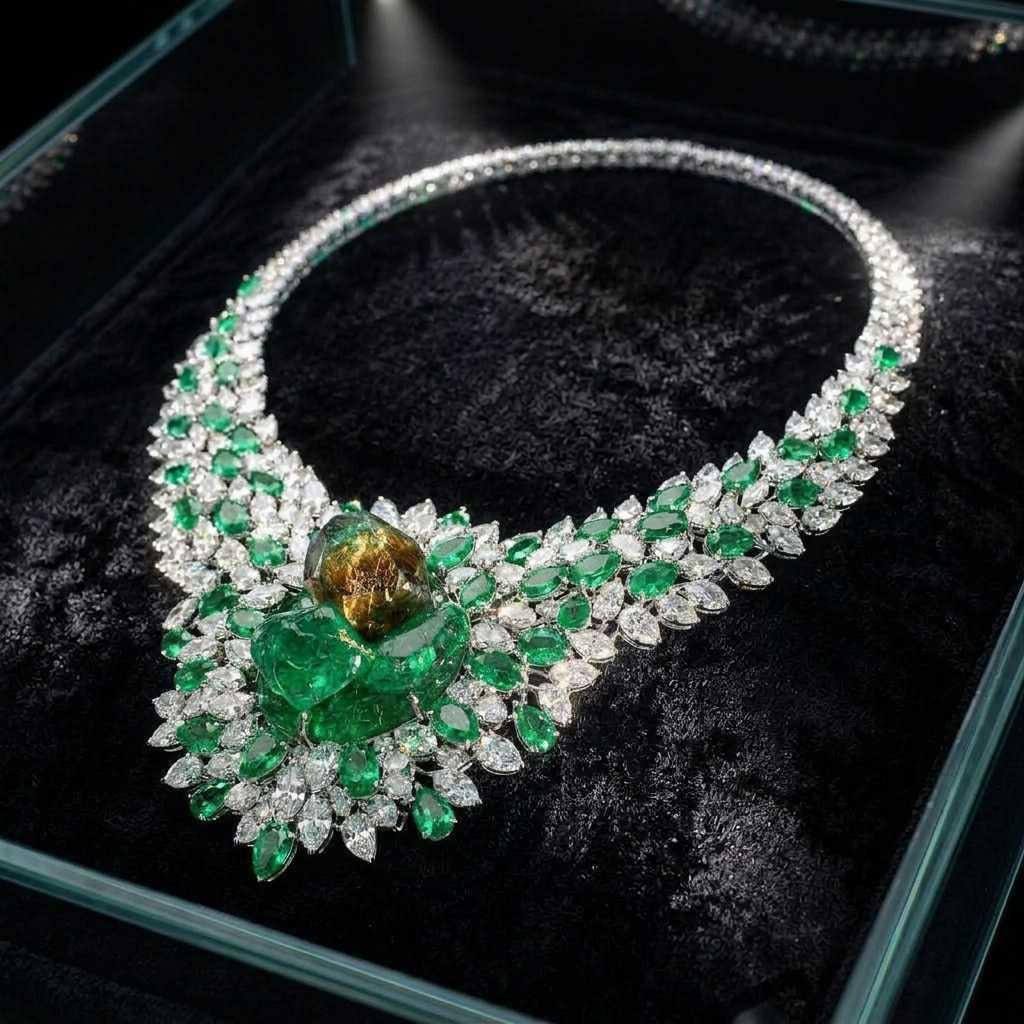
A $33 Million Necklace Quietly Unveiled in Dubai
In April 2026 in Dubai, a choose group of collectors and connoisseurs have been discreetly launched to an distinctive necklace. At its centre lies a pure, unenhanced Ural Alexandrite weighing 68.57 carats. For these conversant in the implications of such an outline, no additional rationalization is required. For others, some context is important.
What Sets This Stone Apart
Alexandrite is a uncommon number of chrysoberyl, distinguished by its outstanding means to vary color relying on the sunshine supply. In daylight,it presents a wealthy, deeply saturated inexperienced, earlier than reworking below incandescent gentle right into a vivid purplish-red. This phenomenon—generally known as the alexandrite impact—is extensively thought to be one of the crucial placing optical occurrences within the pure world.
The best Аlexandrites traditionally originate from the Ural Mountains in Russia. Their defining attribute is the purity and depth of the color change: from a cool bluish-green in daylight to a wealthy raspberry-red below synthetic gentle, notably free from the brownish overtones usually current in stones from different deposits. This high quality is the results of a exact pure steadiness of chromium and iron distinctive to the area. That supply, nonetheless, is successfully exhausted. The Ural deposits that produced Аlexandrite have been largely depleted throughout the nineteenth and Twentieth centuries and are actually closed to industrial mining. What stays in circulation immediately consists solely of fabric extracted over practically two centuries. Early Twentieth-century educational information observe that wonderful Ural Alexandrites hardly ever exceeded 5 carats as soon as lower, with stones above one carat already thought of distinctive.
The mineral’s inherent brittleness, mixed with uneven color distribution, leads to vital weight reduction throughout slicing. At 68.57 carats, the stone on the centre of this necklace shouldn’t be merely uncommon. It is an anomaly. The Necklace The design attracts on the traditional image of the Ouroboros—the serpent representing eternity, cyclical time and transformation. Here, it’s rendered not as a damaging pressure, however as a guardian: its emerald physique encircles the composition, suggesting steady motion and contained vitality. At its coronary heart rests the 68.57-carat Ural alexandrite—an object that isn’t solely uncommon however traditionally resonant. Comparable stones are now not mined, and the final vital discoveries date again to the period of the Romanov dynasty. The Alexandrite is about inside an open lotus motif composed of diamonds and emeralds, a symbolic reference to religious awakening and the passage from type to essence. The composition is additional complemented by 48 Colombian pear-shaped emeralds. The complete weight of all gems within the necklace quantities to 226.98 carats.
Certification
The necklace has been examined and documented by three impartial gemmological laboratories:
● GRS Gemresearch Swisslab (Switzerland, July 2024) — confirmed the alexandrite as a pure, unenhanced chrysoberyl of Russian origin, exhibiting a pronounced color change from inexperienced to purplish-red
● GIA (Gemological Institute of America, July 2024) — issued a report on the emerald cameo, figuring out it as pure emerald
● ICA GemLab (October 2024) — documented the total traits of the piece, together with the alexandrite’s dimensions: 30.38 × 19.25 × 17.31 mm
Key Specifications
● Central alexandrite — 68.57 ct, Russia, pure, unenhanced
● Emerald cameo — 120.34 ct, Russia
● Colombian emeralds — 48 pear-shaped stones
● Total gemstone weight — 226.98 ct
● Valuation — $36,000,000
A Stone with Imperial
Associations Alexandrite was found within the Ural Mountains in 1834 and named in honour of the long run Tsar Alexander II. Its distinctive inexperienced and pink hues echoed the colors of the Imperial Guard, securing its place inside the symbolism of the Russian Empire. Jewellery set with alexandrite was reserved for members of the imperial household and the very best ranks of the court docket. Owing to its rarity, wonderful specimens have been at occasions thought of extra precious than diamonds. Mineralogist Alexander Fersman famous that distinctive stones usually had no established market worth, as they seldom appeared on the market. Today, Ural alexandrites of significant measurement are largely held in institutional collections, together with the Fersman Mineralogical Museum in Moscow, the Mining Museum in St Petersburg, and the Ural Geological Museum in Yekaterinburg. Historic items hardly ever floor at public sale.
On Rarity and Value
Exceptional colored gems from finite geological sources have traditionally demonstrated robust worth retention—notably when no future provide exists. In the case of Ural alexandrite, the scenario is definitive: the supply shouldn’t be merely depleted, however closed. No new materials will enter the market. The sensible implication is evident: there is no such thing as a comparable benchmark for a stone of this measurement and character. A 68-carat unenhanced Ural alexandrite has no true precedent within the open market. The asking worth of $36 million displays not solely the intrinsic qualities of the gemstone, however the improbability of its existence. For collectors who view distinctive gems as moveable, tangible shops of worth—belongings current past monetary programs and carrying intrinsic historic weight—such an object represents one thing basically irreplaceable. This shouldn’t be a matter of positioning. It is a matter of geology.
What Comes Next
The necklace can be offered privately in Hong Kong im May-June 2026. Whether it finds a purchaser right here or is obtainable elsewhere, its very look in circulation constitutes a uncommon occasion—one which sometimes attracts the eye not solely of collectors, but in addition of gemmological establishments and public sale specialists. Objects of this nature seldom return to the market. In some instances, they don’t return in any respect.